 |
| Credit: IPA |
Showing posts with label Industrial Robot. Show all posts
Showing posts with label Industrial Robot. Show all posts
Tuesday, May 17, 2011
Intutitive Robot Control

Friday, April 8, 2011
IFR expects growth for Industrial Robotics
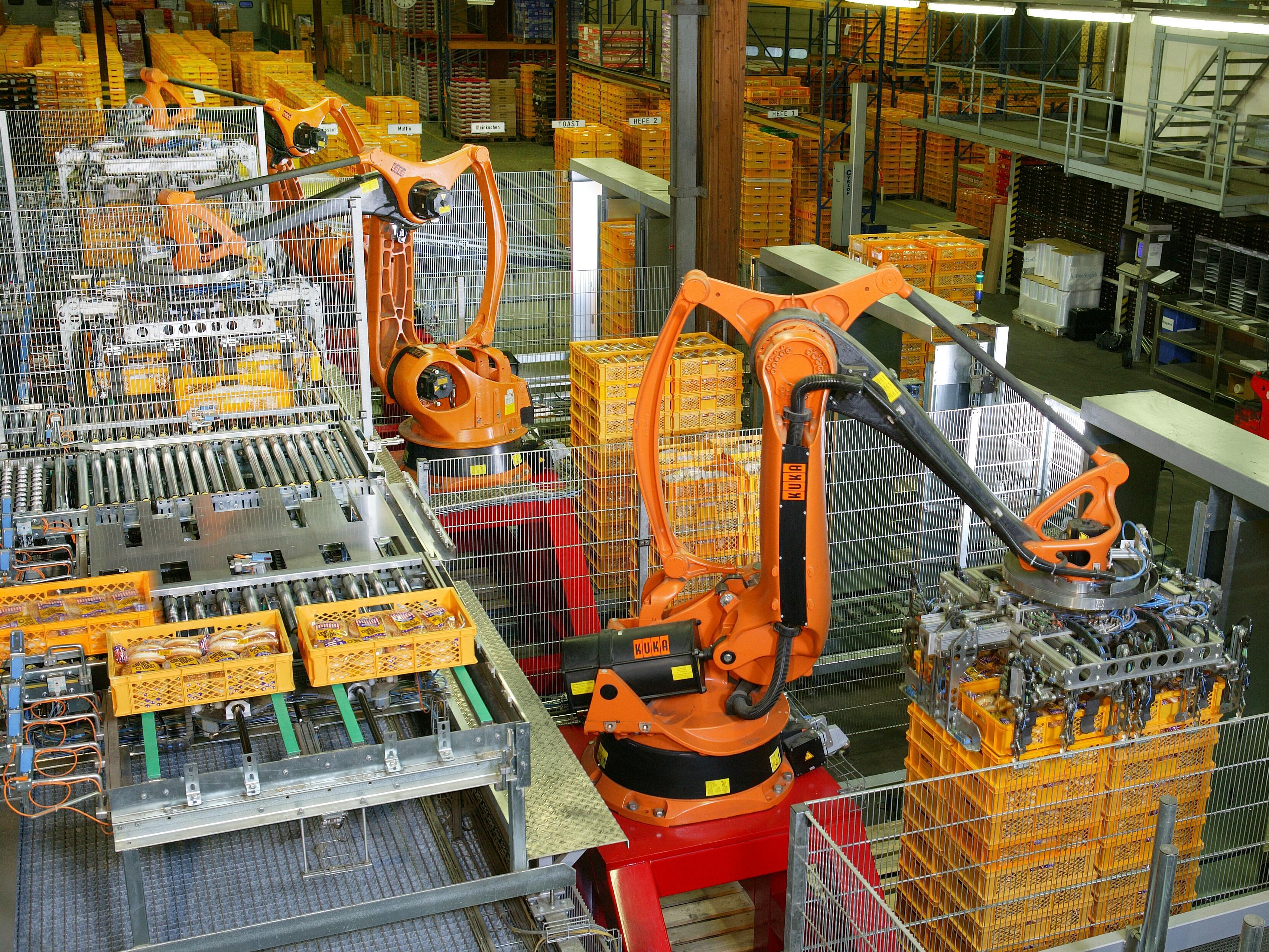
The prospects for 2011 and beyond are promising as the robotics industry benefits from the increasing demand for automation especially in the Asian growing markets with China on the top. Before the natural disaster in Japan IFR expected a further increase of robot sales between 10% and 15% in 2011 which would bring a new peak level of about 130,000 sold units within reach. Between 2012 and 2014 a moderate annual growth rate of 5% (in average) is more likely. A revised IFR prognosis that takes into account substantial earthquake effects on the Japanese economy expects that the growth rate for 2011 will be less than 15% and that the growth rate for 2012 will be above 5%. The shortage of energy in Japan and the partly destruction of production sites in certain areas of Japan will very likely lead to a shortage of components for robots for the Japanese market but also for the export markets. This will lead to a further prolongation of delivery times for robots.
Friday, March 25, 2011
Robots in Nuclear Decommissioning
 |
| Credit: NDA - Brokk 40 |
Instead of concentrating on totally remote/robotic methods, the approach seems to be developing to use long handled tools with shielding or to create a less hostile environment by identifying and removing the high sources of radiation as early as possible.
The reports refers to three projects with robot manipulators that proved to be expensive to build, as well as complicated and expensive to maintain and service. Successful use is reported by the British Nuclear Fuels plc ( BNFL) Sellafield B204 Primary Separation Plant for the removal of stainless steel hulls from a storage silo using a remotely operated loading vehicle.
---------------
The mission of the NEA is to assist its member countries in maintaining and further developing, through international co-operation, the scientific, technological and legal bases required for the safe, environmentally friendly and economical use of nuclear energy for peaceful purposes. To achieve this, the NEA works as a forum for sharing information and experience and promoting international co-operation; a centre of excellence which helps member countries to pool and maintain their technical expertise and a vehicle for facilitating policy analyses and developing consensus based on its technical work.
Wednesday, January 26, 2011
$71 million for Alabama Robotics Technology Park
The Alabama Robotics Technology Park (RTP) is a collaboration between the state of Alabama, Calhoun Community College, Alabama Industrial Development Training (AIDT), and robotics industry leaders across the nation. RTP will consist of three individual training facilities each targeted to a specific industry need. The three buildings will have an investment of approximately $71 million including robotics equipment.
- The Robotic Maintenance Training Center was opened on September 15, 2010 and house an industry training program where technicians will be trained to work on robotic machinery. The 52,000 square foot facility will be staffed by trainers supplied by top robot builders and will be home to several major robotics and automation brands.
- The Advanced Technology Research and Development Center will feature a test facility for companies currently in the robotics manufacturing industry. The 30,000 square foot facility will be used for the purpose of research, development and testing of leading edge robotics used for military projects and space exploration. The structure will have appropriate infrastructure to support these activities with substantial outdoor areas for testing in a variety of environments.
- The Integration and Entrepreneurial Center will be a collaborative consolidation of technology involving higher education and industry. This facility will allow companies to build and adapt robots for new industries. Start-up plants will be able to set up manufacturing lines to integrate software and equipment, test systems and train maintenance and production staff.
Tuesday, September 28, 2010
Universal Robotics Makes Robots Learn Faster
Universal Robotics, Inc. unveiled its flagship technology, Neocortex™, a revolutionary, patent-protected software that that allows machines to learn from their experiences in the physical world. Launched at the Council of Supply Chain Management Professionals’ (CSCMP) Annual Global Conference in San Diego, California, Neocortex makes flexible automation in unstructured environments possible for the first time.
“With Neocortex, we’ve given industrial robots the ability to adapt and react to the world around them and execute tasks in an ever-changing environment, said David Peters, CEO of Universal Robotics. “With this ability to learn, machines will be implemented in revolutionary ways across industries.”
Neocortex has been in development since 2001. It was created at Vanderbilt University with funding from DARPA and NASA and developed using Robonaut, NASA’s humanoid robot.
Unlike traditional automation, in which machines are pre-programmed with movements and tasks to execute, Neocortex allows a robot to learn how to complete a task. Once the task is learned, the machine observes its environment through more than 50 channels of sensor data. Drawing on what it learned from previous experiences, the Neocortex-enabled robot changes its actions as necessary in real time to complete the task.
Universal Robotics partnered with Yaskawa / Motoman Robotics, the world leader in industrial robots, to provide a hardware/machine intelligence work cell solution that features Neocortex software, Motoman’s SDA-series robots, custom box moving end effectors and a suite of sensors, including Universal’s recently launched easy-to-use 3D vision system Spatial Vision.
“With Neocortex, we’ve given industrial robots the ability to adapt and react to the world around them and execute tasks in an ever-changing environment, said David Peters, CEO of Universal Robotics. “With this ability to learn, machines will be implemented in revolutionary ways across industries.”
Neocortex has been in development since 2001. It was created at Vanderbilt University with funding from DARPA and NASA and developed using Robonaut, NASA’s humanoid robot.
Unlike traditional automation, in which machines are pre-programmed with movements and tasks to execute, Neocortex allows a robot to learn how to complete a task. Once the task is learned, the machine observes its environment through more than 50 channels of sensor data. Drawing on what it learned from previous experiences, the Neocortex-enabled robot changes its actions as necessary in real time to complete the task.
Universal Robotics partnered with Yaskawa / Motoman Robotics, the world leader in industrial robots, to provide a hardware/machine intelligence work cell solution that features Neocortex software, Motoman’s SDA-series robots, custom box moving end effectors and a suite of sensors, including Universal’s recently launched easy-to-use 3D vision system Spatial Vision.
Tuesday, September 22, 2009
RepRap - The Future of Manufacturing
"Think of RepRap as a China on your desktop."-
Chris DiBona, Open Source Programs Manager, Google Inc., 8 April 2008.
The RepRap Project is an initiative aimed at creating a largely self-replicating machine which can be used for rapid prototyping and manufacturing. A rapid prototyper is a 3D printer that is able to fabricate three dimensional artifacts from a computer-based model.
Project authors describe 'self-replication', understood as the ability to reproduce the components necessary to build another version of itself, as one of the goals for the project. It is self-replication that distinguishes the RepRap Project from the similar Fab@Home project.
Chris DiBona, Open Source Programs Manager, Google Inc., 8 April 2008.
The RepRap Project is an initiative aimed at creating a largely self-replicating machine which can be used for rapid prototyping and manufacturing. A rapid prototyper is a 3D printer that is able to fabricate three dimensional artifacts from a computer-based model.
Project authors describe 'self-replication', understood as the ability to reproduce the components necessary to build another version of itself, as one of the goals for the project. It is self-replication that distinguishes the RepRap Project from the similar Fab@Home project.
Wednesday, September 9, 2009
ABB Sweden coordinates 10MEUR robotic project
The 4-year ROSETTA project coordinated by ABB Sweden started March 1st, 2009, and has a total budget of 10 MEUR. The goal of the project is to develop “human-centric” technology for industrial robots that will not only appear more human-like, but also cooperate with workers in ways that are safe and perceived as natural. Such robots will be programmed in an intuitive and efficient manner, making it easier to adapt them to new tasks when a production line is changed to manufacture a new product.
ROSETTA is the acronym for a new European Large-Scale Integrating Research Project “RObot control for Skilled ExecuTion of Tasks in natural interaction with humans; based on Autonomy, cumulative knowledge and learning”.
ROSETTA is the acronym for a new European Large-Scale Integrating Research Project “RObot control for Skilled ExecuTion of Tasks in natural interaction with humans; based on Autonomy, cumulative knowledge and learning”.
Subscribe to:
Posts (Atom)


