Showing posts with label fire fighting robot. Show all posts

Tuesday, March 22, 2011

New Water Cannon Robots Arrive at Fukushima Dai 1

The Cooling Fight at Fukushima Dai 1 continues. Personnel from Japan's Self-Defense Forces, the Tokyo Fire Department, and other agencies are spraying water on the plant's No.3 and 4 reactors, which lost the ability to cool storage pools containing spent nuclear fuel rods.

Water Cannon Robot from Australia
NHK reports that a remote-controlled high-powered water cannon truck has arrived from Australia at  Yokota Air Base on Tuesday following a request by the United States. The water cannon robot can shoot 150 liters of water per second at a target 150 meters away. It can also operate unmanned for 2 to 3 days while pumping seawater. The robot, owned by US contractor Bechtel Corporation, the largest engineering company in the United States, was being flown from Perth by an RAAF Hercules transport. The robot sprayer will probably be put to work in the reactor building in the most dangerous condition, No 4. The robot will enable them to remotely see the damaged pool for the first time and put water into it with precision.

62 Meter Concrete Pump from China

Credit: Sany Group
Chinese Sany Group, the world’s largest concrete machinery manufacturer and among the top 50 global construction machinery manufacturers, has announced the shipment of its 62 meter concrete pump to Fukushima free of charge to help Tokyo Electric Power Company (TEP) fight against the current crises. The equipment has left Sany head quarter in Changsha and is now heading towards Shanghai. It is estimated that the concrete pump will arrive in Japan on next Wednesday. According to Guinness World Records Sany boasts the longest boom for a truck-mounted concrete pump: 71.535 meters.

According to IEEE Spectrum the head of the U.S. Nuclear Regulatory Commission told a congressional committee on Thursday, that building No. 4's storage pool had lost all its water, leaving its spent fuel exposed to the air. On Friday the Los Angeles Times reported that the No. 4 pool had either been cracked or breached during the earthquake, causing water to drain away. However, TEPCO officials have contradicted these statements.

Thursday, March 17, 2011

Firefighting Robot for Nuclear Power Station from Croatia

Time is running out for the Fukushima site and the need of a robotic firefighting solution is urgent. While the world is asking why there are no Japanese robots fighting the nuclear heat, and leading robot experts refer to prototypes only, privately owned Croatian company DOK-ING Ltd. might have a solution. The company established in 1991 and registered for the production of robots and equipment for special purposes is one of the international leaders in designing and manufacturing remote controlled firefighting robotic vehicles MVF-5.

March 21: DOK-ING has informed Robotland, that there are only two prototypes machines at their facility in Zagreb and that operators/fireman need two-week training for this new technology. 

The MVF-5 is unique remote controlled fire fighting system developed to fight fires in hazardous and inaccessible areas. It is designed to help fire-fighters to do their job in the most challenging and dangerous conditions. The MVF-5 is the third product launched by DOK-ING and was designed based on the development of the previous DOK-ING machines. The system is an example of a highly sophisticated robotic system incorporating the latest fire fighting technologies that enable users to extinguish fires with minimal personnel and vehicle damage. The remote-control system allows the user to remain outside the range of danger during operation. The system is effective in clearing a path for traditional fire fighting vehicles in difficult terrain.
The standard operating tool mounted in front of the vehicle is a hydraulic arm and blade tool attachment which allows the system to grip and remove obstacles. The MVF-5 has a Ziegler water pump with a range of 55 m and tanks with a capacity of 1800 l of water and 600 l of foam.
The MVF-5 can effectively operate in the following locations: Oil refineries and chemical plants, chemical storage areas, nuclear power stations, military storage depots, transportation of flammable materials, forests
urban environments.


FP7 Project FIREROB

DOK-ING was awarded a grant in the amount of EUR 803,000 for the technological improvements of the Jelka Fire Fighting System. Through this program, a new joint remote control system will be developed with incorporated video system with thermal cameras, GPS positioning system, pattern recognition system, and multilayer thermo reflecting paint. The project has gathered the consortium of four small & medium enterprises: Croatian DOK-ING as a coordinator, Spanish MESA, Greek Kampakas and Definet along with 2 scientific institutions: Croatian Institute of Naval Engineering and SCOT-Atri from Scotland.
http://www.firerob.info/

Firefighting Robots in Japan

Robotland asked some of the world leading rescue robotics researchers, why there are no firefighting robots operating at the Fukushima site. One reason mentioned was that the reachable distance/height of spraying would not be enough for this plant, in addition to the radiation issue. Most firefighting robots are small type UGV or only prototypes. But it was also mentioned that Japanese power plant companies haven´t seen a need of such robots because they considered their nuclear plants as safe and free from accidents.


Firefighting Robot Development in Japan
The development of practical high-performance robots that are affordable to fire headquarters have been implemented with the objective of developing robots for NBC terrorism by 2006. NBC disasters are special disasters including Nuclear disasters caused by nuclear radiation and radioactive substances, Biological disasters caused by pathogenic microorganisms such as viruses, rickettsia and microbes, and Chemical disasters caused by toxic chemicals.  
In 2006 a Firefighting Technology Policy Office was established in the Fire and Disaster Management Agency (FDMA) of the Ministry of Internal Affairs and Communications (MIAC). The FDMA and its National Research Institute of Fire and Disaster, NRIFD, conduct research to address the common challenges for all prefectures of Japan, including development of equipment for emergency firefighting assistance teams and development of an information system for coping with large scale natural disasters including earthquakes.
Credit: Mitsubishi/NRIFD (FRIGO-M)
NRIFD  in Tokyo is the only institute in Japan engaged in comprehensive research on firefighting and disaster prevention. NRIFD conducts developmental research on robots that assist with firefighting activities, such as information collection and rescue efforts, in areas where firefighting personnel find it difficult to enter, including fires at nuclear power plants and areas affected by the release of toxic gases due to terrorism. Extreme environmentally-resistant modifications, including waterproofing, dustproofing and shock resistant capabilities that allow the robot to be used directly at the scene of fires, have been made, and robots are being introduced in experimental programs for practical deployment in the future.

The robot “FRIGO-M” is capable of autonomously recognizing and following a firefighter wearing firefighting clothing etc., automatically recognizing and memorizing the path of movement taken, and autonomously transporting disaster victims found by the firefighter to safety by retracing the path. The FRIGO-M robot has a main body that is highly waterproof, dustproof, explosion-proof, and shock-resistant.


Local Fire Fighting Research & Development 

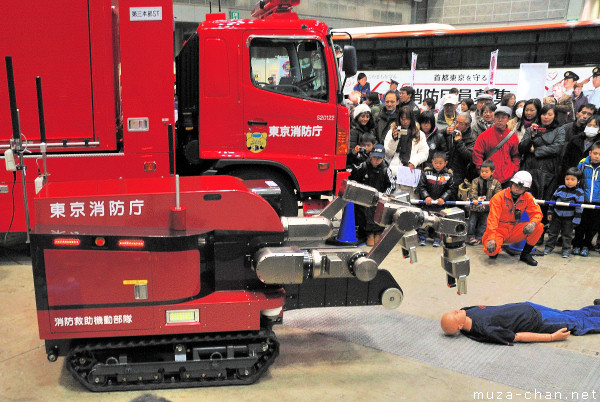
Credit: Muza-Chan - Robocue Tokyo FD

Several types of firefighting robots have also been developed by local government firefighting departments in Tokyo, Osaka, Kanagawa etc. Most of them are small type UGV. A large unmanned spraying robot of Tokyo Firefighting department has been used for large-scale fires, such as at Bridgestone fire incident.
The Tokyo Fire department has 12 different types of fire fighting and rescue robots. These robots are designed to handle disasters that are too dangerous for personnel during an emergency. Some types of robots can shoot water or foam on to fires. One type can rescue a person and another type are able to move large objects. Currently all robots are controlled by remote operators. Robocue is a remote-controlled rescue robot, used by Tokyo Fire Department since 2009. Robocue was built to save lives in case of disasters, being capable to pull a person inside its body (using a sort of pincers and a conveyor belt) and to carry it to safety.

Fire Fighting Robots for Fukushima Cooling

Japanese military helicopters dumped water on an overheating Fukushima nuclear plant on Thursday while the United States expressed growing alarm about leaking radiation and said it was sending aircraft to help Americans leave the country. But where are the Fire Fighting Robots?
According to IFR Service Robot 2010 report many prototypes of fire- and bomb-fighting robots have been designed but very few designs have been commercialized. IFR exspects that up to the end of year 2009 about 1000 units of fire and bomb fighting robots have been sold.

Fire Fighting Robots 2011

The diesel-powered LUF60 from Austrian Rechners GmbH  is a wireless remote controlled mobile fire-fighting support unit, which clears the path for advancement of up to a distance of 300 m by incorporating a high capacity positive pressure ventilator and a “water beam” fog. This combination clears away smoke, heat, toxic gases and reduces the intensity of the fire, allowing fire-fighting and rescue teams to more safely approach the incident.


The FFR-1 Fire Fighting and Rescue Wireless Robot of InRob Tech Ltd., Israel,  is an example of a robot designed for high-risk fire-fighting missions, allowing fire-fighters to carry out operations that were hitherto impossible because of physical constraints or risk to human life.

Komatsu Fire-Fighting Robot

Credit: Komatsu
The award-winning Komatsu fire-fighting robot is remote-control fire-fighting robot is relatively compact in size for combating blazes in urban environments. An array of 8 high-resolution wide-angle cameras provides a panoramic view of the surroundings, and a multi-channel control system allows 10 fire-fighting robots to be deployed simultaneously. Special nozzles that are 10 times more powerful than those on conventional fire hoses allow the robot to blast flames with 5,000 liters of water per minute.

Korean Hoya Robot has developed a compact 2 wheeled rolling robot is intended to be used by fire-fighters as their personal spy. Despite its heavy armour and robust look, it measures only 12.5 centimeters in diameter and weighs 2 kilograms. This robotic device can be thrown into a building on fire and operate there for 30 minutes. As it can withstand temperatures up to 160°C, fire-fighters can explore the environment and plan their actions accordingly using this remote controlled robot.

Dear reader, if you have knowledge about any other fire fighting robot manufacturer please send link or data to Robotland for adding at this page. Thank you for cooperation!


Wednesday, February 10, 2010

Fire Fighting Robots against Pirate Attacks

The increased number of attacks in the Gulf of Aden off the African shore has forced several countries, including Russia, to send warships to patrol the troubled waters.

The Centre of Fire Robots Technology in Petrozavodsk, northern Russia, has modified a fire fighting robot to fend off attacks by pirates. It can ‘wash away pirates along with their weapons’ and even sink their boats.

A total of 12 robotized security fire robot are needed to protect a ship. Security fire robot SFR-LSD-S40U in Marine Modification, with discharge 40 l/s, at the range of 70 m under discharge 0.8 MPa, it is supplied with round-the-clock observation and moving sensors. The system of TV-observation allows determining of moving units and their coordinates in the adjacent water area.

The water cannon is powerful enough to wash away boarding pirates and even sink their motorboats.

Friday, April 24, 2009

Robots for telemedicine and fire fighting

The sixth annual RoboBusiness Conference and Expo in Boston focused on personal, service and mobile robotics. CCS Robotics has also developed a mobile robot called RoboRounder™ that can be facilitate for tele-medicine. A doctor in Sweden can visit patients in USA without the need for on-site assistance. Once connected over the internet or via 3G wireless link, simply tell the RoboRounder to go to a specific room. Manual driving and camera control can be used once the robot has arrived at the patient's bedside. Fully integrated medical records, charts, and tele-stration are visible to the patient and family members via the robot's large 17" LCD. Telemetry and medical instrument integration allows instant access to the patient's status as well as 2-Way video conferencing. The ultimate accessory to the Apple iPhone, RoboRounder™ can also be used for remote sales, engineering, supervision, and teaching.

Segway introduced a new robot based on the RMP 400 robotic platform and can move at 18 miles an hour while carrying up to 400 pounds. It is also armed with a water cannon than can fire 10 gallons of liquid per second. Segway envisions the robot being used for mostly fighting forest fires, but also a small amount to be used for crowd control. Segway has stated an experimentell project called P.U.M.A. (Personal Urban Mobility & Accessibility) to develop next generation personell tranportation system.